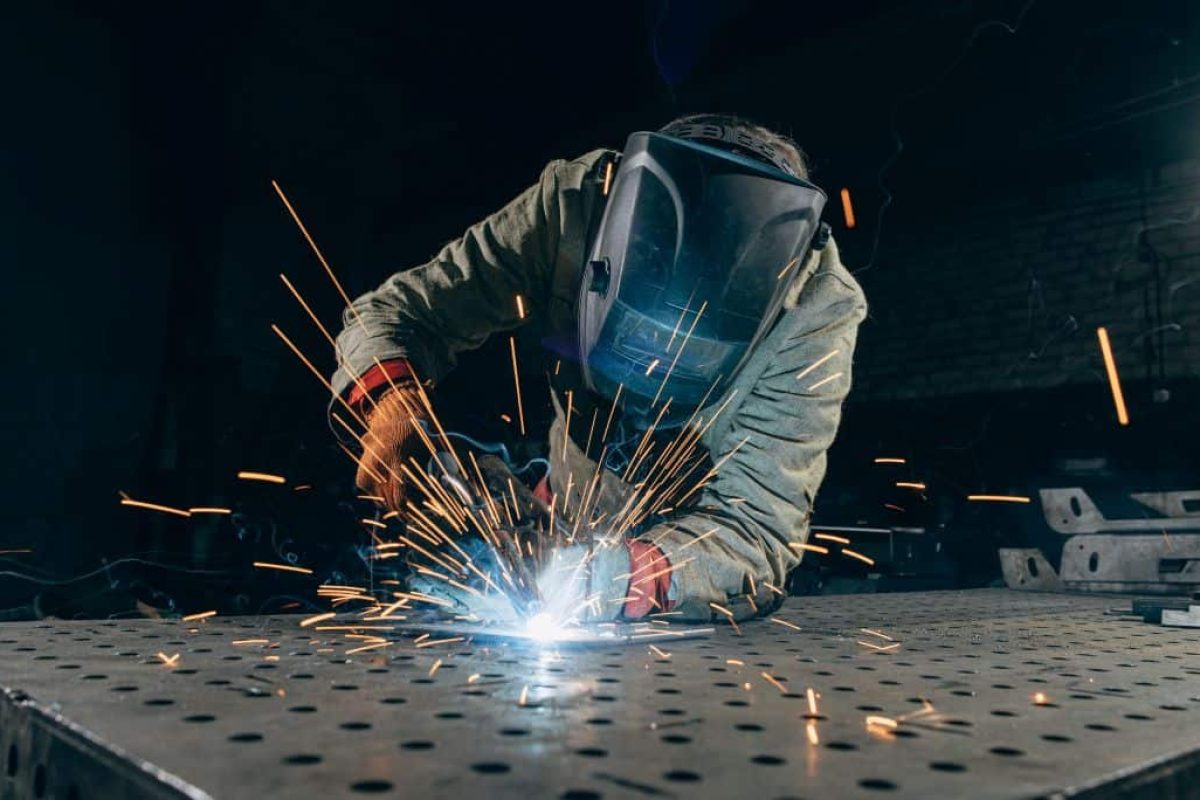
HY-100 is not a steel you figure out as you go. Engineered for submarine pressure hulls and deployed on platforms from Seawolf-class attack submarines to Ford-class carriers, it carries a minimum yield strength of 100,000 psi — and weld quality requirements to match. When a fabrication scope calls for HY-100 under NAVSEA oversight, the qualification process is demanding by design: the standards governing it were written for welds that cannot fail.
Armes Precision Manufacturing has worked through the NAVSEA qualification framework for HY-100 welding, including the procedure qualification testing, documentation, and nondestructive inspection that define readiness to produce under these requirements. What follows is a technical overview of what that process involves.
What HY-100 Is and Where the Navy Uses It
HY-100 — “HY” for high-yield, “100” for the minimum yield strength in ksi — is a quenched-and-tempered, low-alloy steel the U.S. Navy developed in the 1960s as a higher-strength successor to HY-80. NAVSEA specification T9074-BD-GIB-010/0300 constrains yield strength to a bracketed range of 100-120 ksi (690-897 MPa). That upper bound matters: over-strengthened HY-100 grows more brittle and harder to weld. The specification caps both ends deliberately.
Today, HY-100 appears in submarine pressure hull structures, surface combatant hulls and decks, Ford-class carrier hull structure, and ordnance components requiring notch toughness in cold seawater service. The Seawolf-class submarine is the most recognized application — its hull operates at depths beyond what HY-80 designs could reach, with a crush depth of approximately 2,250 feet.
Toughness requirements reflect those stakes. Per T9074-BD-GIB-010/0300, HY-100 plate must achieve a minimum average Charpy V-notch energy of 70 ft-lbs at -120 degrees F and 90 ft-lbs at 0 degrees F, with minimum shear fracture of 50% and 90% respectively. Qualification testing expects weld metal and heat-affected zones to meet comparable standards.
The Core Weldability Challenge: Hydrogen-Assisted Cracking
HY-100’s alloy chemistry — nickel (2.25-3.50%), chromium (1.00-1.80%), and molybdenum (0.20-0.60%), with carbon up to 0.20% — gives it the hardenability and toughness the Navy requires. It also drives the carbon equivalent higher, making the steel susceptible to hydrogen-assisted cracking (HAC), also called cold cracking or underbead cracking.
In practice, the mechanism works like this: hydrogen enters the weld zone from moisture, electrode coatings, or atmospheric humidity. As the weld cools, that hydrogen diffuses into the heat-affected zone. HY-100’s high hardenability drives the HAZ to transform largely into martensite — a hard microstructure that traps diffusible hydrogen. Under residual tensile stress, the hydrogen-saturated martensite cracks at temperatures below roughly 300 degrees F, typically hours to days after welding ends. A weld that passes visual inspection in the afternoon may fail magnetic particle testing the next morning.
NAVSEA addresses HAC risk through mandatory low-hydrogen filler material classifications (MIL-100S, MIL-101TM, MIL-11018-M under defined thickness restrictions), strict surface cleanliness requirements, preheat and interpass temperature controls, and electrode handling procedures that limit atmospheric exposure time after baking. Qualified fillers carry a diffusible hydrogen content of 5 ml/100g or less, tested per AWS A4.3. Mitigation, in short, is not optional.
The NAVSEA Qualification Framework
NAVSEA Technical Publication S9074-AQ-GIB-010/248 — commonly called TP-248 — governs welding procedure and performance qualification for Navy fabrication. Shops must develop a Procedure Qualification Record (PQR) for every welding procedure before production begins. That PQR must demonstrate that the procedure, executed by qualified welders, produces welds that pass both nondestructive and destructive testing.
TP-248 draws a critical distinction between procedure qualification and performance qualification. Procedure qualification demonstrates that a documented set of welding variables — base material, filler, shielding gas, current, voltage, travel speed, position, preheat, and interpass temperature limits — can produce a sound weld. Performance qualification demonstrates that a specific welder can execute that procedure. Importantly, a welder without performance qualification on a given Welding Procedure Specification (WPS) cannot perform production welds against it.
A change to any essential variable triggers partial or full requalification. Essential variables include heat input above the qualified maximum, filler material, arc transfer mode (spray to short-circuiting, for example), and base material thickness outside defined limits. Additionally, TP-248 paragraph 4.7.10 adds a requirement specific to S-10H base materials such as HY-100: shops must qualify repair welds that do not fully remove the original weld and HAZ to the maximum depth and for the maximum number of repair cycles planned for production.
Controlling the Variables That Matter
Heat Input
For HY-100, heat input carries a hard ceiling. Per T9074-AD-GIB-010/1688, the maximum average heat input per weld pass for base plate 1/2 inch and greater is 55,000 J/in; for thinner sections, 45,000 J/in. Use this formula to calculate it:
Heat Input (J/in) = (Voltage x Amperage x 60) divided by Travel Speed (in/min)
Exceeding the qualified heat input — even by slowing travel speed to fill a wider gap — triggers an essential variable change and demands requalification. For repair welds deeper than 1/4 inch and larger than 16 square inches, the ceiling drops to 45,000 J/in regardless of plate thickness. As a result, in-process parameter monitoring is a production requirement, not a quality control option.
Preheat, Interpass Temperature, and Filler Selection
Preheat and interpass temperature requirements vary by filler material and joint geometry. With MIL-100S or MIL-101TM filler, preheat ranges from 125 degrees F (high-cooling-rate qualifications) to 225-275 degrees F (low-cooling-rate qualifications). Measure temperature on the welding-side base metal surface within 3 inches of the weld area, using temperature-indicating crayons or calibrated devices. Do not apply crayons inside the weld groove — this contaminates the joint. Measure interpass temperature within 1 inch of the joint edge.
The three most common production processes for HY-100 are FCAW (MIL-101TM with 75% Argon/25% CO2), GMAW in spray or pulsed-arc mode (MIL-100S-1 or MIL-100S-2), and SMAW (MIL-11018-M, limited to base material 1.0 inch or thinner on pressure-hull structure unless NAVSEA approves otherwise, with a minimum preheat of 225 degrees F for joints where at least one member is 3/4 inch or thicker).
NDT: Every HY-100 Weld Gets Inspected
NAVSEA T9074-AS-GIB-010/271 governs nondestructive testing requirements for HY-100 welds, with acceptance criteria from MIL-STD-2035A. A complete PQR test sequence covers visual testing throughout welding, magnetic particle testing (MT) after welding, then radiographic (RT) and/or ultrasonic testing (UT) on the weld volume. All NDT must finish before teams cut any destructive specimens.
That sequencing is deliberate: failed volumetric NDT ends the qualification without consuming the destructive testing budget. The one-repair rule under TP-248 paragraph 4.2.9 is equally unambiguous — a PQR test assembly gets one repair, using only the procedure under qualification. If that repair fails NDT, start over with a fresh test plate. Teams that stage their NDT results before cutting specimens — and plan their repair budget accordingly — avoid compressing this timeline against a program schedule.
MIL-STD-2035A rejects cracks of any type, size, or orientation in a weld, regardless of acceptance class. NAVSEA requires NDT personnel to hold ASNT SNT-TC-1A Level II qualification for weld interpretation and Level III for procedure authoring. NDT subcontractors must also maintain written qualification and certification procedures, available for review by the prime contractor or government inspector.
Frequently Asked Questions
What is TP-248 and why does it govern HY-100 welding?
NAVSEA Technical Publication S9074-AQ-GIB-010/248 (TP-248) is the Navy’s primary document for qualifying welding and brazing procedures and the personnel who perform them. It covers manual, semi-automatic, automatic, and machine welding across ferrous and nonferrous materials. For HY-100, TP-248 defines the Procedure Qualification Record (PQR) framework, Welding Procedure Specification (WPS) content, welder performance qualification requirements, and the essential variables that trigger requalification when changed. Any shop producing HY-100 weldments for Navy programs must hold TP-248-qualified procedures and performance-qualified welders before production begins.
Why does HY-100 have both a minimum and a maximum yield strength requirement?
Most structural steels specify only a minimum yield strength. NAVSEA specification T9074-BD-GIB-010/0300 brackets HY-100 between 100 and 120 ksi. The reason for the upper limit: over-strengthened HY-100 carries a higher carbon equivalent, greater susceptibility to hydrogen-assisted cracking, and reduced fracture toughness. Those characteristics degrade performance in the cold, high-stress environments where the Navy uses this steel. The bracket ensures the material retains the toughness that makes it viable for pressure hull applications.
What filler materials does NAVSEA approve for HY-100 welding?
NAVSEA T9074-BC-GIB-010/0200 governs filler materials for HY-100. Principal options include MIL-101TM and MIL-101TC (FCAW electrodes), MIL-100S-1 and MIL-100S-2 (bare GMAW wires), and MIL-11018-M (SMAW covered electrode, with thickness restrictions on pressure-hull structure). For applications requiring higher joint efficiency, MIL-120S-1 is an option. The “LH” suffix identifies low-diffusible-hydrogen electrodes that may qualify for reduced preheat when NAVSEA Materials Engineering specifically approves it. Manufacturers must provide certifications demonstrating compliance with the specification, and shops must store and handle electrodes per the WPS to prevent moisture pickup.
What destructive testing does an HY-100 PQR require?
A complete PQR submittal under TP-248 typically includes transverse tensile tests (two specimens), all-weld-metal tensile tests (two specimens), side bend tests (three specimens), and Charpy V-notch impact tests at the required temperatures — typically three weld-metal specimens per temperature. The fabrication document may also require HAZ specimens. Because the HAZ notch must land in a microstructural region often only 1-3 mm wide, preparation is exacting. Teams perform all destructive testing after NDT acceptance. Failed NDT concludes the qualification attempt without cutting a single destructive specimen.
Can a contract manufacturer earn NAVSEA-qualified procedures without being a shipyard?
Yes. TP-248 applies to any fabricator performing work on Navy programs, not only to shipyards. Prime contractors and OEMs routinely flow NAVSEA welding requirements down to qualified subcontractors. To qualify, a subcontractor needs approved WPSs backed by PQRs, performance-qualified welders, and a quality system that can sustain the required records, calibration data, and inspection documentation. Certifications such as AS9100D and ISO 9001:2015, combined with ITAR registration, are the typical baseline for shops entering this supply chain.
Welding HY-100 for Navy programs requires more than capable welders and good equipment — it requires a qualification structure that can survive program scrutiny from procedure development through final NDT. The NAVSEA framework is demanding because the applications demand it. Shops that have built the documentation infrastructure and trained their teams to the standard are the ones prime contractors rely on when schedule and traceability are non-negotiable.
Armes Precision Manufacturing holds AS9100D and ISO 9001:2015 certifications and is ITAR registered, with precision welding capabilities supporting defense programs with rigorous quality requirements. Contact Armes Precision today to discuss your project requirements.